What Parents Should Look for in a Safe Magnetic Wall for Kids
Magnetic play walls have become a familiar sight in playrooms and nurseries. They give children a spot to build, sort, and create without needing a table full of loose pieces. But not every magnetic wall for kids is built the same way, and the differences matter more than they might first appear.
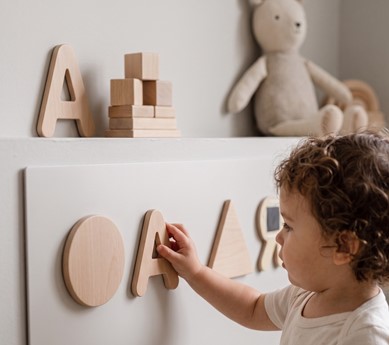
A play wall sits close to where your child sleeps, breathes, and spends unsupervised time. That makes material choice, adhesive type, and surface durability worth a closer look before you buy. Below is a practical guide to what actually separates a safe, well-made magnetic play wall from one that just looks good in a product photo.
Why Material Safety Comes First
Children under five explore with their hands and, often, their mouths. A magnetic wall panel gets touched, pressed, leaned on, and occasionally chewed at the corner. Whatever the panel is made from ends up in close contact with your child for hours at a time.
This is where odor becomes a useful clue. A strong chemical smell straight out of the box usually points to off-gassing, the process by which certain plastics, adhesives, and coatings release volatile organic compounds (VOCs) into the air as they cure. The US Environmental Protection Agency notes that VOC concentrations are frequently higher indoors than outdoors, and that these compounds are emitted by a wide range of household products, including some plastics, paints, and adhesives commonly used in furniture and décor.
For a nursery or playroom, this matters more than it might in a garage or garden shed. A genuinely child-safe panel should be odorless or close to it once unpacked. If a product smells strongly of plastic or glue days after arrival, that's worth questioning, not ignoring.
Look for panels that state clearly what they're made from and whether they've been tested against recognised safety standards. In the UK, the BS EN 71 series sets out mechanical, chemical, and flammability requirements for children's products, covering everything from small parts to substance migration. A manufacturer that references this standard, or an equivalent, is giving you something more concrete than a "non-toxic" label with no backing.
Adhesive Technology Matters More Than You'd Think
Most magnetic walls attach to a surface somehow, whether that's a full mount or a lighter peel-and-stick system. The adhesive used here is worth checking for two reasons.
First, cheaper adhesives can carry the same VOC concerns as the panel material itself, particularly in the early weeks after installation when off-gassing is highest. Second, a poor adhesive either damages your wall on removal or fails to hold the panel securely, which becomes its own safety issue if a heavy panel comes loose.
Non-toxic adhesive systems designed specifically for children's environments tend to strike a better balance: strong enough to stay put during daily play, but formulated without the harsh solvents found in general-purpose adhesives. When a product page specifies this, it usually means the adhesive has been considered as part of the design, not added as an afterthought.
Surface Durability: What Daily Play Actually Looks Like
A magnetic wall in a home with toddlers or preschoolers gets a very different life than one in a showroom. Letters get dragged across the surface. Magnets get pressed hard, dropped, and occasionally thrown. Little fingernails scratch at edges out of curiosity more than mischief.
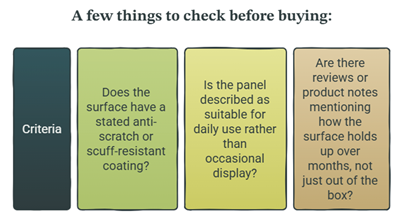
An anti-scratch surface is one of the more practical features to look for, because it's the one you'll notice missing within the first few weeks. Panels without this kind of coating start to show fine scratches quickly, which dulls the finish and can make the board look worn well before the toy itself is outdated.
Durability isn't just about looks. A board that wears down fast often ends up replaced sooner, which is neither cost-effective nor particularly sustainable.
Magnetic Grip: The Feature That Prevents Frustration
Weak magnets are one of the most common complaints with budget magnetic toys. If letters and shapes slide off with the slightest bump, play sessions turn into a cycle of picking pieces up off the floor, which is frustrating for a small child still building patience and fine motor control.
Strong, consistent magnetic grip is what makes independent play actually work. A toddler building a word or a pattern needs the pieces to stay where they're placed long enough to see the result of their effort. That small win, seeing a shape stay put, is part of what makes this kind of play satisfying rather than annoying.
When comparing options, it helps to check whether the grip strength is mentioned specifically, rather than just described as "strong." Reapply-friendly systems, where pieces can be moved and repositioned without weakening over time, tend to hold up better across repeated use than those relying on lower-cost magnets.
Move-and-Reapply Flexibility
Children's interests shift quickly, and so does the layout of a playroom. A magnetic wall that can be repositioned without leaving marks or losing its hold gives parents more flexibility than a fixed installation.
This matters for renters and homeowners alike. Move-and-reapply panels let you shift a play area from a bedroom wall to a playroom, or reconfigure a space as your child grows out of toddler play and into more structured activities like early writing practice. It also means the panel can travel with your child's interests rather than dictating them.
Design That Fits the Rest of the Home
Practical features aside, a lot of parents care about how a play wall looks in a shared living space. Bright primary colours and cartoon branding have their place, but not every household wants that as a permanent fixture in the lounge or hallway.
Tix&Mix is one example of a magnetic wall board built around this exact checklist: odorless materials, a dedicated non-toxic adhesive system, an anti-scratch matte coating, and a move-and-reapply design, while still keeping a neutral, Montessori-inspired look that fits a living room as easily as a playroom. Design and durability don't have to be a trade-off.
The Developmental Case for Magnetic Play
Beyond safety and looks, magnetic walls earn their place in a playroom because of what they support developmentally.
Fine motor skills
Picking up small magnetic pieces, positioning them, and pressing them into place all require the kind of hand and finger control that supports later skills like writing and buttoning clothes. This is similar groundwork to what's built through puzzles and other manipulative toys recommended for age-appropriate play.
Early literacy
Magnetic letters let children experiment with spelling and word-building at their own pace, without the pressure of getting it right on the first try. Rearranging letters on a vertical surface also introduces left-to-right movement patterns that are relevant to early reading.
Creativity and open-ended play
Unlike toys with a single "correct" outcome, a magnetic wall can become a farm scene one day and an abstract pattern the next. The American Academy of Pediatrics has highlighted play as a core driver of healthy child development, noting that unstructured, child-led play supports problem-solving and creative thinking better than more prescriptive activities.
Independent play
A well-designed magnetic wall gives a child something to return to on their own, which matters for parents trying to build pockets of independent play into the day without hovering over every activity. This kind of setup pairs well with the broader idea of building a safe, functional playroom where a few well-chosen items do more work than a room full of clutter.
A Quick Checklist Before You Buy
* Does the product state its materials clearly, with no strong chemical smell reported?
* Is there any reference to recognised safety testing, such as EN 71 compliance?
* Is the adhesive described as non-toxic and suitable for children's spaces?
* Does the surface have anti-scratch or scuff-resistant properties?
* Is the magnetic grip strong enough for repeated daily use?
* Can the panel be moved and reapplied without losing its hold?
* Does the design suit the room it's going in, not just the toy aisle?
Final Thoughts
A magnetic play wall can be one of the more durable, flexible additions to a child's play space, but only if the basics are right. Odorless materials, a sensible adhesive, a scratch-resistant surface, and reliable magnetic grip aren't extras. They're what determine whether the wall holds up to daily toddler use or ends up replaced within a year.
Once those fundamentals are covered, the rest comes down to fit: a design that works with your home, and a size that matches your space. Get those pieces right, and a magnetic wall earns its spot as one of the more quietly useful things in the playroom.