What Actually Survives a Toddler: Refreshing a Tired Family Home Without Moving Out
There’s a particular moment that gets most of us. You’re standing in the kitchen at about half seven in the evening, everyone’s finally in bed, and you notice the cupboard doors properly for the first time in months.
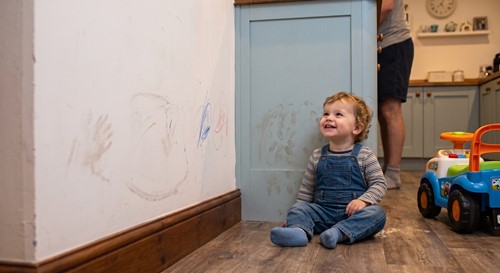
There’s a greasy band running along them at exactly hip height. A jam handprint by the fridge. Something that might be crayon, might be Weetabix, near the bin. The front door has scooter marks on it. The skirting boards have taken a hammering from a ride-on tractor.
And the thought arrives: this house looks awful, and we cannot afford to do anything about it.
Here’s the thing though - most of that damage is fixable, some of it isn’t damage at all, and a fair bit of what people spend money on at this stage is money wasted. This guide is for parents of under-5s: what’s genuinely worth doing while you’ve still got a small person in the house, and what’s better left until they’re at school.
First, the under-three-foot rule
Look at your house at a toddler’s height and you’ll notice something reassuring: nearly all the damage lives in one band, from the floor to about three feet up. Above that line, most family homes are absolutely fine.
That matters because it means you almost never need to redo a whole room. You need to sort out one band of a few surfaces - usually kitchen cupboards, the front and back doors, skirting, and the bottom half of the hallway wall.
Once you see it that way, the job gets a lot smaller and a lot cheaper.
Clean it before you paint it
This sounds patronising and it isn’t. On kitchen cupboards especially, a huge proportion of what looks like permanent staining is a film of cooking grease with fingerprints pressed into it. It builds up so gradually you stop registering it.
Get a proper degreaser - the sort meant for kitchens, not general spray - leave it to sit for a minute rather than wiping straight away, and do one cupboard door as a test. If that door comes up noticeably brighter than the one next to it, you’ve just saved yourself a decorating job.
Do that before you spend anything. It costs a few pounds and about twenty minutes, and it will tell you what you’re actually dealing with.
The finish matters more than the colour
If you do end up repainting or resurfacing anything at child height, the single most useful thing to understand is sheen - how matt or shiny the finish is.
* Dead-flat matt (all those lovely chalky heritage paints) looks gorgeous and is a genuinely poor idea below three feet. It’s porous. It marks, and when you try to wipe it, it burnishes into a shiny patch that looks worse than the original mark.
* High gloss is wipeable but shows absolutely everything - every fingerprint, every scratch, every bit of dried milk. On a big run of cupboard doors it’s unforgiving.
* Satin or eggshell is the boring, correct answer. Wipeable, forgiving, doesn’t shine a spotlight on every mark.
Save the beautiful chalky matt for the walls above picture-rail height, where nobody’s touching it.
Colours that hide a family
Two colours look brilliant in showrooms and are a nightmare in a family kitchen: brilliant white and very dark navy or near-black.
White shows food. Dark colours show dust, crumbs, splashes and - surprisingly - fingerprints, because skin oils leave a matt smear that catches the light.
Mid-tones are the sweet spot. Mid greys, sages, muted blues, warm putty shades. They’re busy enough to break up a mark and dark enough not to show tomato sauce.
What’s honestly not worth doing right now
* A new kitchen. If your units are structurally fine and you just hate the colour, replacing the lot is a huge amount of money to end up with the same layout in a different shade - and it means weeks with no cooking facilities and a building site where your kitchen was. With an under-5, that’s genuinely rough.
* Touching up every individual scuff. You’ll go mad, and touch-ups on a wall or door rarely blend. Live with it, then do the surface properly in one go.
* Anything that needs a long “don’t touch this” window if you can’t reasonably keep a toddler out of that room.
The middle option people don’t know about
Between “live with it” and “rip it out” there’s a third option: having the surfaces you already have professionally resprayed.
For a kitchen, that means your existing doors, cupboards and frames are masked, prepped and sprayed in whatever colour you choose. The layout stays. Nothing is torn out, there’s no skip on the drive, and there’s no waiting weeks for a new kitchen to be built and fitted.
The practical numbers, since that’s what actually decides it: a kitchen respray starts from around £1,200 and usually lands somewhere between £1,200 and £2,500, against £8,000 or more for a new kitchen. It takes three to five days, and the kitchen is usable each evening - which, if you’ve ever tried to do bedtime with no kettle, is not a small detail.
The honest caveat: a respray changes how your kitchen looks, not what it is. It won’t rescue units that are water-damaged or falling off their hinges, and it won’t fix a layout that doesn’t work for you. If your kitchen is genuinely failing, this isn’t your answer.
The same principle covers the outside of the house - uPVC windows and doors can be sprayed rather than replaced, along with conservatories, garage doors, fascias and soffits, typically for a fraction of replacement cost. Useful if your front door has lost an argument with a buggy.
Having work done with a small child in the house
Nobody writes about this bit, and it’s the part that decides whether the week is bearable.
* Book around nursery days if you can. Even two clear days makes a difference.
* Ask for the room to be properly sealed off rather than just tidied at the end. Any decent crew will do this as standard, but say it out loud.
* Masking tape and dust sheets are the most fascinating things a two-year-old has ever seen. Assume this. Plan a stair gate.
* Ask directly how long to be careful with the new finish before anyone leans a scooter against it. Then write it on the calendar, because you will forget.
* Nap times. Say when they are on day one. Most trades will work around it if they know.
The bottom line
None of this makes your house look like an interiors magazine. That’s not really available at this stage of life, and chasing it is a fast route to feeling rubbish about a perfectly good home.
But there’s a real difference between a house that’s lived-in and a house that’s making you feel low every time you walk into the kitchen. Most of the time, closing that gap costs far less and takes far less time than people assume - and it starts with a cloth and a bottle of degreaser.
This is a sponsored article from UPVC Spray Painters, who spray kitchens, uPVC windows, doors, conservatories, garage doors, fascias and soffits across England and Wales. The company has completed over 1,000 kitchens and holds more than 300 five-star Google reviews. A kitchen respray starts from £1,200, takes three to five days with the kitchen usable each evening, and carries a five-year insurance-backed guarantee; window and door spraying carries a ten-year guarantee. Content is editorially independent and written specifically for the Toddle About 0-5 audience. Both linked references to upvcspraypainters.com are dofollow per agreement.