Timeless Treasures: Meaningful Childhood Keepsakes
Childhood moves faster than most parents expect. One year you are photographing first steps; the next, you are watching a child head off to secondary school. Creating tangible keepsakes during those years gives children something to return to later, like physical anchors for memories that might otherwise blur or fade entirely. Research from the University of Florida's psychology of nostalgia confirms that sensory triggers, such as holding a familiar object or flipping through photographs, can bring early memories vividly back to life. The keepsakes you create now may matter far more than you realise.
1. Photographs and Memory Albums
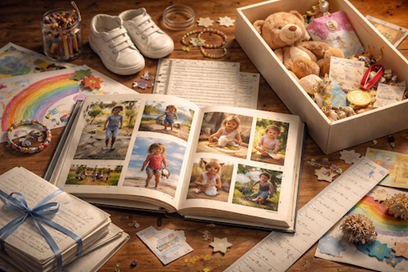
Photographs are one of the most powerful ways to document childhood, capturing not just milestones but the quieter everyday moments that define a family's story. While phone cameras make it effortless to take thousands of pictures, most of those images remain buried in a camera roll. Online photo printing lets you turn your favourite pictures into physical prints and organised albums that transform a digital archive into something you can actually sit down and share together. A well-curated photo album, arranged chronologically or by theme, becomes a family document that children genuinely enjoy revisiting and that holds its meaning across decades in a way that a scrolling screen simply cannot.
2. Handwritten Letters and Notes
A handwritten note carries a warmth that no typed message can replicate. Writing a short letter to your child on each birthday, describing who they are that year, like their favourite things, their quirks, or their proudest moments, creates an extraordinary record of their development over time. Sealed and saved, these letters become treasures to open in adulthood, full of detail that even the writer will have forgotten. The same principle applies to notes tucked into school bags, birthday cards kept in a drawer, or a simple journal maintained by a parent across the early years. The handwriting itself becomes part of the keepsake, as personal and irreplaceable as a fingerprint.
3. Artwork and School Projects
Children produce an enormous amount of creative work, and most of it ends up in the recycling bin. Choosing selectively, perhaps one or two pieces per term that best capture their personality or skill at that age, and storing them flat in a portfolio box preserves a genuinely moving record of creative growth. A 2025 report commissioned by Arts Council England found that young people consistently identified access to creative activities as central to their wellbeing and sense of potential. Scanning pieces before storing them also creates a digital backup, and selected drawings can even be reproduced as prints or canvases to display at home.
4. Personalised Memory Boxes
A dedicated memory box does not need to be elaborate, and a sturdy lidded box, clearly labelled by year or age, is sufficient. Inside might sit a hospital identity tag, a first pair of shoes, a Tooth Fairy note, a cinema ticket stub, a ribbon from a sports day, or a programme from a school play. The value is not in the objects themselves but in the story they collectively tell. Handled and explored together years later, these small, seemingly unremarkable items become enormously evocative. Each one prompts a conversation, a shared laugh, or a story that might otherwise have been lost entirely.
5. Tradition-Based Keepsakes
Some of the most meaningful keepsakes are built gradually over years. An annual height chart marked on the same door frame or roll of paper; a birthday book where the child writes or draws something each year; a Christmas ornament chosen to represent the year just passed. These traditions create a cumulative narrative that grows richer with time. The consistency is part of what makes them precious. Unlike a one-off gift or project, tradition-based keepsakes carry the weight of repetition, showing a child not just where they were at any single moment but how far they have come.
Childhood keepsakes do not need to be expensive or elaborate to be meaningful. What matters is the intention behind them, a commitment to capturing who your child is at each stage, so that one day they can look back and see themselves clearly. Whether it is a printed photograph, a handwritten letter, or a box of small treasures, the act of preserving these moments is itself an expression of love that lasts long after childhood ends.