Thinking About an Electric Scooter for Your Child? What Parents Should Consider First
Thinking about an electric scooter for your child? Learn what parents should consider, from age and size to speed, braking, safety and suitable riding areas.
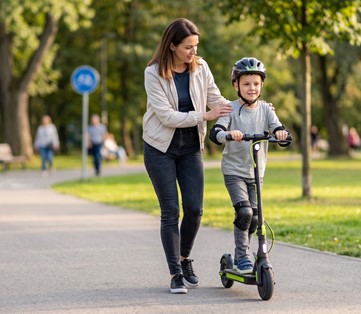
There is a particular stage of childhood when getting outside becomes much more interesting if there is a set of wheels involved.
A bike, scooter, skateboard or even a pair of roller skates can turn an ordinary trip to the park into something a child is suddenly very keen to do.
Electric scooters add another option, although they are one that deserves a little more thought from parents. There is the excitement of having a motor, of course, but there is also speed, battery charging, maintenance and the question of whether your child is actually ready to use one.
If you are considering buying one, I would start with the child rather than the scooter.
Is your child ready for an electric scooter?
Age is an obvious starting point, but it is not the only thing that matters.
A six-year-old who is already confident on a conventional scooter may be more comfortable than an older child who is still learning to balance. Children develop coordination and confidence at different rates, so a manufacturer's recommended age should be treated as a starting point rather than the whole decision.
I would look at a few basic things.
Can your child steer without constantly looking down? Can they slow down and stop deliberately? Do they understand that they need to watch where they are going rather than simply following friends?
If the answer to those questions is yes, you have a better starting point.
It is also worth letting them get comfortable on a normal kick scooter first. Learning how to turn, balance and stop without a motor gives children some useful habits before introducing powered riding.
Start slowly
This is probably the biggest piece of advice I would give another parent.
The first ride does not need to be exciting.
In fact, it is better if it is slightly boring.
A quiet, open area with plenty of space gives a child the chance to get used to the controls without worrying about pedestrians, traffic or other riders. Start at the lowest available speed and let them practise accelerating gently, turning and braking.
Modern children's electric scooters often have different speed settings for exactly this reason.
The isinwheel S7 electric scooters for kids, for example, has three riding modes of 5, 8 and 12 mph. It also has an electronic brake operated from the handlebar alongside a rear foot brake.
That gives parents a straightforward way to start with a slower setting and increase the pace as the child becomes more confident.
There is no prize for reaching the fastest setting on the first afternoon.
Fit matters more than parents sometimes realise
Children grow quickly, which makes buying equipment for them slightly frustrating.
Something can fit perfectly in September and look noticeably smaller by the following summer.
That is why adjustable handlebars are worth looking for when choosing a children's scooter.
The S7 has three handlebar positions, ranging from 87.5 cm to 99.5 cm, and is designed around growing riders. The manufacturer recommends it for children from around six years old, with the exact fit depending on the child's height.
I would still check the actual dimensions rather than relying on age alone.
Two children of the same age can be very different in height, arm length and confidence.
A scooter that feels comfortable and controllable is going to be much more enjoyable than one that is technically the right age category but awkward for the child to handle.
Make safety part of the fun
Children are remarkably good at becoming excited and forgetting everything their parents have just told them.
That is why safety equipment should not feel like a lecture.
A properly fitted helmet is an obvious starting point. Depending on where and how your child rides, knee and elbow protection can also be useful, particularly while they are learning.
I would also make a simple rule that the scooter only comes out when the safety gear is on.
That way, there is no debate every time you go outside.
Parents should also check the scooter before each use. Look at the tyres, brakes, handlebars and visible cables or connections. If something feels loose or damaged, leave the ride for another day.
Battery-powered toys can feel like ordinary children's equipment, but the battery deserves attention too. Use the supplied or manufacturer-approved charger, follow the charging instructions and avoid using a battery or charger that appears damaged.
Where should children ride?
This is an important question in the UK.
Buying a children's electric scooter does not mean that your child can simply ride it anywhere they would ride a normal kick scooter.
Privately owned e-scooters have specific legal restrictions in the UK. They cannot currently be ridden on public roads, pavements or other public land, and private land requires the landowner's permission.
That means parents should check the rules for the location before letting their child ride.
Your local park may allow ordinary scooters and bikes while prohibiting electric scooters. A private garden may be suitable, provided there is enough space and the surface is appropriate. A private campsite or holiday property may have its own rules.
It is worth checking first rather than finding out after you arrive.
Think about the type of riding your child actually enjoys
Some children want to ride around the garden for 20 minutes and then move on to something else.
Others will happily spend an entire afternoon outside.
That makes a difference when choosing a scooter.
If your child is likely to use it for short bursts of outdoor play, portability may matter more than battery range. If they enjoy longer sessions, you may want to pay more attention to battery capacity and comfort.
The S7 is relatively light at around 6.9 kg and folds down for storage and transport. Its stated maximum range is up to 10 miles, with up to 120 minutes of play time under the manufacturer's stated conditions.
Those figures are useful when comparing models, although real-world battery life will vary depending on the rider, speed, terrain and other conditions.
For most families, I would be more interested in whether the scooter suits the child's normal playtime than whether it has the longest possible range.
The fun features matter too
There is nothing wrong with admitting that children care about how something looks.
Adults might compare battery capacity and braking systems. Children are often more interested in lights.
The S7 has a front headlight as well as ambient lighting around the stem and deck. It also supports Bluetooth music playback.
These features are not a substitute for good safety design, but they can make a child more interested in actually using the scooter.
And that is one of the better things about outdoor wheeled activities in general. If your child is excited about going outside, they are more likely to spend less time sitting indoors with a screen.
Don't turn every ride into a family expedition
One thing I would avoid is making the scooter another activity that needs to be organised perfectly.
Sometimes children just want to go outside and ride around.
There does not need to be a ten-mile route or a full afternoon itinerary.
A short session after school can be enough. Ride for half an hour, come back home, have a drink and move on to something else.
That is especially useful when children are still learning.
As their confidence grows, you can gradually introduce longer rides in appropriate locations and make the scooter part of a wider family day outdoors.
What I would look for as a parent
If I were choosing a children's electric scooter today, I would probably make a short checklist rather than getting distracted by the biggest numbers on the product page.
First, fit. Can the child comfortably reach the controls and stand naturally on the deck?
Second, speed control. Are there slower settings for learning?
Third, braking. Can the child understand and operate the brakes easily?
Fourth, weight. Can an adult carry the scooter without struggling?
Fifth, adjustability. Can the scooter accommodate a growing child?
Finally, where can it actually be used? This should be answered before buying, not afterwards.
These things are more useful than simply asking which model has the highest top speed.
Let Them Earn Their Confidence
The best part of watching a child learn a new physical skill is seeing the confidence build gradually.
The first few minutes might be cautious. They may wobble, stop too often or ask you to walk alongside them.
Then, eventually, they stop looking back.
That is usually the point when parents start feeling a little nervous.
It is also the point when the earlier lessons about slowing down, watching the route and wearing protective equipment become important.
A children's electric scooter can be a fun way to encourage outdoor play and independence, provided it is treated as a proper piece of equipment rather than simply another toy.
Choose something that fits the child, start at a sensible speed, supervise them appropriately and make sure you know where they can legally ride.
The rest is usually the easy bit.
Give them some space, and they will probably show you exactly how much fun they can have with it.
About the author
Sophie Turner is a UK-based parent and family lifestyle writer who enjoys finding simple ways to get children away from screens and outdoors. She writes about family activities, children's hobbies and the practical side of making everyday adventures work for parents.