The Sharing Platter Trick: A Calmer Way to Do Teatime with a Toddler
You cooked it, you cut it up, you plated it, and before it touched the table you could see the answer forming. Most of us respond by tinkering with what’s on the plate, hiding a different vegetable in the sauce, then trying again Thursday. Never fear, there’s another approach that has nothing to do with what you cook and everything to do with how it arrives. Put it on a board.
Why a Board Works When a Plate Doesn’t
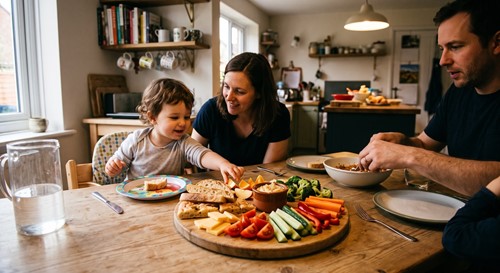
A plated meal asks a toddler one big question, and they can answer it in one word. A board asks a dozen small ones. There’s bread, there’s cheese, something orange, and something new at the edge. Some gets eaten, some gets prodded, and none of it carries the weight of a single dish they’ve rejected.
It also fits how small children eat. Their appetite swings wildly day to day, and a board lets them take what they need without anyone negotiating over a portion size. Registered dietitian Sarah Almond Bushell has written for Toddle About on the benefits of serving meals family style, where food goes in the middle of the table and everyone helps themselves. A sharing platter is that idea scaled down to a Tuesday and a tired parent.
Start With the Bread
Bread is usually the safe bet on a board. It’s familiar, it’s easy to chew, it’s mild enough not to provoke an opinion, and it’s often the first thing a toddler picks up while they decide how they feel about everything else. That’s genuinely useful, as a child who’s already eating something is far more relaxed about the pepper sitting next to it.
It’s worth a bit of thought when shopping, though, because bread is one of those foods where the ingredients list tells you more than the loaf does. Plenty of everyday sliced bread is made fast, with emulsifiers and preservatives doing work that time used to do, and bread is one of the bigger sources of salt in a typical British diet.
Real bread needs four things: flour, water, salt, and yeast or a sourdough starter. Italian bakery Panificio Italiano has a useful explainer on what separates real bread from highly processed alternatives, and the short version is that the difference is mostly time. A slow ferment does naturally what additives are brought in to fake. In practice that points you towards the fresh bakery counter, or at least towards a loaf with a short ingredients list.
Ciabatta and focaccia both suit a board well. They tear rather than crumble, hold up to being dunked in oil or soup, and they’re soft enough for a child who’s still working out how chewing goes.
Filling the Rest of the Board
After the bread you’re assembling rather than cooking, which is most of the appeal. Aim for five or six things and don’t overthink them.
Something with protein usually anchors it. Cheese is the obvious one, but flaked salmon, a hard-boiled egg, leftover chicken or a spoonful of beans all do the job. Then two or three vegetables in different colours, because a board is one of the rare formats where variety costs nothing extra. Cucumber, pepper, cooked carrot, whatever needs using up. Add a fruit, and something to dip into: hummus, cream cheese, plain yoghurt, a puddle of good olive oil.
The nice trick is that a board looks generous while staying modest. British Nutrition Foundation guidance on portion sizes for toddlers and pre-schoolers puts a serving of bread at roughly half a slice to a whole one, vegetable sticks at two to six, and cherry tomatoes at one to three. Spread across a board, that reads as plenty rather than a sad little plate.
It also makes repetition painless. Children often need to meet a food many times before they’ll try it, and a board lets you keep putting it out with no expectation attached. Nobody has to eat the pepper. The pepper is simply there again, which is the point.
Keeping It Safe for Under-Fives
Grazing food needs preparing with care, and it’s worth understanding what to be cautious with, rather than going on instinct. Small round foods are the ones to watch, because they sit close to the size of a young child’s airway. NHS advice on preparing food safely for young children recommends quartering grapes and cherry tomatoes rather than halving them.
Firm vegetables want cutting into narrow batons instead of chunks, or softening by steaming first. Cheese is better grated or in short, narrow strips than cubed. Whole nuts are out entirely for the under-fives, and hard pips and skins are worth removing where you can.
Bread has its own note, which surprises a lot of parents. Soft white bread can form a dough-like ball in the throat if it isn’t chewed properly, so the advice is to toast it lightly or use brown varieties instead. Always cut any bread into narrow strips, rather than handing over a torn hunk.
The setting for teatime matters as much as the food. Everyone sitting down, the child upright rather than reclining, an adult at the table throughout, and nobody carrying food off round the house. Grazing invites wandering, so that’s the one habit worth being firm about.
Making It a Habit
Once a week is plenty to start. Friday works well, when the fridge is full of odds and ends and nobody has the energy to cook twice. What changes first won’t be how much your toddler eats. It will be the mood at the table.