Stealth Learning: Sneaking Maths and Music into Everyday Play
Parents often walk a fine line between ensuring their child develops well and not turning the whole house into a rigid classroom. Supporting a child's progress is important, but forcing them through additional spelling homework after a tough day at school is rarely welcomed by tired minds. This is where sneaky learning becomes tremendously useful. Incorporating learning elements into a child's favourite hobbies allows parents to teach geometry, physics, or even music without the children realising they are participating in a structured lesson.
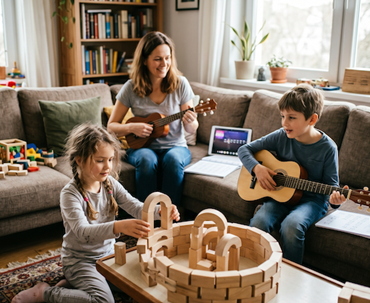
Guided play has been proven at the University of Cambridge to be an extremely effective way to develop numeracy skills in children. Guiding kids' play in a particular direction allows them to develop self-regulation abilities, build confidence, and gain healthy learning habits that benefit them for life. Combining education with daily routines is a fantastic solution. Here are three practical ways to introduce maths and music into favourite everyday pastimes.
Creative Avenues for Everyday Integration
Enhancing Spatial Awareness Through Gaming
First, digital gaming represents a powerful learning tool when managed with clear developmental boundaries. While screen-based entertainment is sometimes viewed with concern, parents can help children safely navigate modern platforms like Roblox through structured guidance on enjoying popular digital experiences. When approached mindfully, popular block-based games like Minecraft become incredible educational environments.
Minecraft acts as a digital box of building blocks, prompting extensive creativity and complex problem-solving. Constructing simple square houses is relatively straightforward, but the challenge increases when a child decides to build curved structures, such as a dome, a circular tower, or a colosseum. Because the entire game consists of cubic blocks, creating curved items requires deep spatial awareness and practical geometry. To help map out block placement, children can use a Minecraft circle generator. This tool visually represents how square blocks can form a smooth curve, sneaking in geometry and structural engineering as they build their digital fortress.
Fostering Auditory Progression Through Music
Then again, one can think about the world of music. Playing an instrument promotes brain development, helping children learn pitch, rhythm, and creative self-expression. Even though formal lessons might become monotonous or pricey, there are budget-friendly options, as mentioned in a previous article on finding a cheap violin for kids. To make things more fun and comfortable, organising a casual family music night is a great alternative.
Gathering around an old acoustic guitar from the attic or a keyboard encourages everyone to experiment without the pressure of being evaluated. Parents do not even need to know how to play; a chord finder can quickly identify basic chords for popular nursery rhymes or favorite animated films. This informal jamming helps children listen to pitch, feel the beat, and observe how notes combine into melodies, all whilst building lasting family bonds.
Incorporating Practical Arithmetic into Crafts
Finally, learning can be integrated into hands-on crafting and baking projects that occupy the whole family. When looking for physical activities to keep little hands occupied, creative tasks featuring circles are perfect for exploring mathematical concepts in a tactile and engaging way.
Whether baking a homemade round pizza, drawing colourful planetary orbits with chalk on a pavement, or cutting out cardboard superhero shields, circular shapes hold a wealth of mathematical secrets.
As families construct these craft projects together, children can be introduced to the physical relationship between a circle's width and its outer boundary. Using a circumference calculator allows parents to easily demonstrate how the diameter measurement directly determines the outer circumference and perimeter. This playful approach introduces complex maths terminology in a practical, real-world context that makes immediate sense to young minds.
Growing Up Loving Learning
In conclusion, stealth learning focuses on discovering rich educational value in everyday family activities and hobbies. Removing the rigid barrier between study time and collaborative playtime allows young children to develop into naturally curious, independent, and highly organized learners. By supporting children in their favorite digital environments, musical explorations, or creative home crafts, play can easily be transformed into a highly rewarding journey of discovery that fosters lifelong development.