Learning Through Play: Simple Activities for Toddlers Aged 0–5
Play is not a break from learning. For children between birth and five, it is the learning. Every time a baby reaches for a rattle, a two-year-old stacks blocks and watches them fall, or a four-year-old negotiates the rules of a made-up game with a sibling, their brain is doing some of its most intensive developmental work. As parents who grew up gaming, many of us already understand this instinctively: the best games teach you through doing, through failing, through trying again. The same logic applies perfectly to the small people crawling around your living room floor.
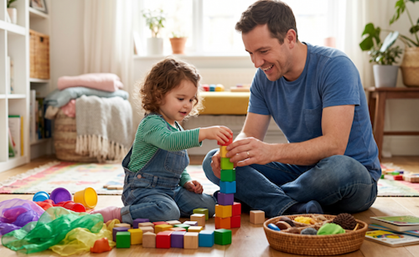
The beauty of play-based learning at this age is that it does not require expensive equipment or structured sessions. What it does require is variety, presence, and a willingness to get on the floor and join in. This guide covers simple, low-cost ideas across the full 0–5 age range, organised by developmental stage.
Babies and Young Toddlers: 0 to 18 Months
At this stage, everything is new. Sensory play is king. Babies learn by touching, mouthing, shaking, and staring, and you do not need a structured activity to support that. A basket filled with everyday objects of different textures, weights, and materials (a wooden spoon, a silicone spatula, a crinkled piece of foil, a soft cloth) is a classic and genuinely effective toy. Treasure basket play, as it is sometimes called, encourages focused independent exploration and builds early concentration.
Tummy time works better as a play opportunity than a chore. Put a small mirror on the floor in front of your baby, or place a few interesting objects just out of reach, and it becomes a proper activity. Narrating your day, talking through nappy changes, naming things on walks, singing the same songs repeatedly: all of this builds language foundations faster than any flashcard.
Toddlers at the Controls: 18 Months to 3 Years
This is when things get messy in the best possible way. At this age, toddlers are starting to experiment with cause and effect, beginning to engage in parallel play alongside other children, and developing the kind of stubborn curiosity that makes both playtime and dinnertime feel like an endurance sport.
Water play, sand, and simple arts and crafts (painting with hands, sticking torn paper, squeezing playdough) are developmentally rich precisely because children can control the outcome. As gamer parents know, the satisfaction of agency, of making something happen, is deeply motivating at any age. Simple construction toys like Duplo or wooden blocks deliver that same loop: build, test, watch it fall, build again.
This age group also starts to enjoy rough and tumble play, chasing games, and basic hide-and-seek. Get on the floor. Chase them. Let them catch you. It sounds silly but the physical contact and the laughter it generates are genuinely important for emotional bonding and for building body awareness and spatial reasoning.
Three to Five: Where Play Gets Complicated
By age three, most children are ready for games with simple rules and a social element. This is where play starts to feel more like, well, play in the grown-up sense.
Board games and tabletop-style activities work brilliantly here, and the market has expanded significantly to accommodate this age group. A giant pass the pigs game, for example, is a fantastic choice for this stage because the oversized dice are easy for small hands to roll, the rules are simple enough to grasp quickly, and the physical comedy of the pig landing on its snout keeps even the most distracted three-year-old engaged for longer than you might expect. Oversized versions of classic games like this also work well outdoors, which adds a layer of physical activity to what would otherwise be a sitting-down game.
Role play becomes very elaborate at this age. Children will set up shops, hospitals, kitchens, and space stations with whatever they can find. Rather than buying dedicated playsets, give them cardboard boxes, fabric scraps, old kitchen utensils, and empty containers. The open-ended nature of these materials means a box can be a boat one day and a rocket the next, building narrative thinking, social negotiation, and problem-solving in ways that more prescribed toys cannot match.
For families where screen time is part of the picture, the 3–5 range is when many gamer parents start exploring accessible digital options. F2P games designed for broad audiences often feature simple mechanics, bright visuals, and short session lengths that suit supervised play with older toddlers, and the zero upfront cost means you can try things without committing. Keep sessions short, sit alongside your child, and treat it as a shared activity rather than a babysitting solution.
The Activities That Work at Every Age
Some play types span the whole 0–5 range and stay valuable throughout. Reading aloud is the obvious one. The specific book matters less than the habit: a child who hears stories regularly develops vocabulary, comprehension, and a relationship with books that classroom learning builds on for years. Music is similarly broad. Singing nursery rhymes with babies, banging on pots with toddlers, dancing to whatever is on in the kitchen at 5pm. None of it requires equipment or planning.
Outdoor play, even in the rain, even for fifteen minutes, is consistently one of the highest-value activities for under-fives. Sticks, puddles, leaves, mud, running, climbing: all of it is rich with sensory and physical learning. It also wears them out.
When the Best Toy Is Just Your Attention
The most honest conclusion to any guide like this is that children at this age are not primarily interested in the activities. They are interested in you. The presence of a parent who is genuinely engaged and willing to be silly is the developmental ingredient that nothing else can replicate. The activities are just the frame. The back-and-forth, the shared attention, the responding to what your child does rather than directing the whole thing: that is where the real learning lives.
Pick whatever activity suits the day. Get on the floor. Follow their lead. That is pretty much the whole game.