Laughter and Play
The two most important ingredients for language development.
By Nicky McKeon Ba (Hons), Bsc (Hons) Speech and Language Therapy, MRCSLT, HCPC
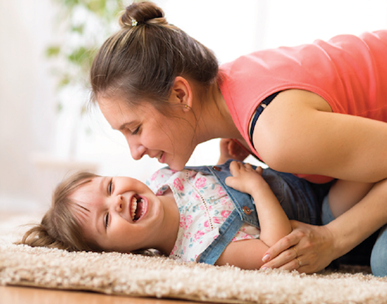
Let’s be honest…When was the last time you got down on the floor and played with your child? And really played? When did you intently watch how your little one played with a toy and then joined in with their game, before introducing your rules of how to play?
The key to supporting positive language development is to laugh and play together every day - even if it is only for 5 minutes.
We know that children develop at different rates, but we also know that the best learning is offered with patience, curiosity and joint attention. In a world dominated by passive electronic devices, the essential ingredients to developing communication skills with your child is through person to person play, using facial expressions, shared awareness and unbridled happiness.
It doesn’t have to be hard or expensive - here are some quick and easy ideas to make you both smile:
Floury Language
A sieve, some flour and a piece of black card in a tray can capture a child’s imagination and enrich their language so easily - think how the flour falling through the sieve could be snow, space dust, fairy dust. Drawing shapes in the fallen flour with your fingers can promote sensory joy and descriptive language (“soft”, “cold”, “like clouds”) and knowing that there has to be a finish and tidy-up helps with transitioning from activities, following instruction and sequencing. Your simple commentary will model language and introduce new and exciting vocabulary.
Story Soundtracks
A shared story book will help you child predict familiar and new situations (“Who’s going to be hiding on the next page?”) and expand memory skills (“What did the caterpillar eat on Tuesday?”) Taking turns to offer instructions is a great way to demonstrate patience and develop resilience, in addition to modelling to your child how to ask for help (“Can you see the butterfly? I can’t find it. Can you help me?”) Making animal noises together during the story is a good way to check out if your child can produce all of their vowel sounds correctly (“Eeek! Squawk! Woof! Moo!”)
Bath Time Banter
Ditch the bath toys for one night and replace with different sized spoons, measuring cups and plastic beakers. This provides a great opportunity to introduce comparative language (big / little, full / empty) and imaginative role play - who wouldn’t want a frothy cappuccino at the Splash Cafe?
Through activities such as these, you can build a closer and more trusting relationship with your child and help to ensure that their language is developing in an appropriate way.
If you have any concerns regarding your child’s speech and language development, speak to your Health Visitor or contact your nearest Independent Speech and Language therapist via the ASLTIP website.. We’re a friendly bunch and can always offer some top tips, ideas to support your child and some reassuring words for you.
But most importantly, have fun and play together every day!

Nicky McKeon is a qualified Speech and Language Therapist. She is a mum to teenagers with a background in commercial marketing and experience in early years and primary education. She is passionate about supporting children’s communication development through fun, accessible approaches for families.