How Venues Can Manage Challenging Behaviour Without Spoiling the Day Out
It's the last hour of a rainy Saturday at a soft play centre. The queue for the café is long, a child has just been told the ball pit is closing for cleaning, and a parent who has already waited 20 minutes for a table is starting to raise their voice at your newest member of staff.
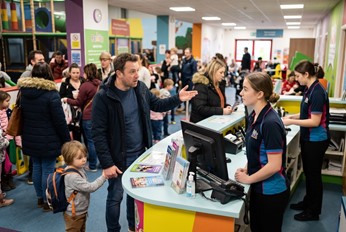
If you run a family attraction, farm park, holiday club or play centre, you'll know that moment. Most visits go smoothly. But busy days, tired children and stretched parents create the conditions where behaviour can tip from frustrated to challenging very quickly. How your team handles those few minutes shapes the visitor's day, your reviews and, just as importantly, how safe and supported your staff feel.
The good news is that managing challenging behaviour is a skill, not a personality trait. It can be learned, practised and built into the way your venue works.
What "challenging behaviour" really means
Challenging behaviour is any behaviour that puts the person, other visitors or your staff at risk, or that stops the venue running safely. At a family attraction it might be a parent shouting at the till, an adult refusing to follow safety rules on a ride, a group becoming intimidating in the car park, or a child in such distress that they lash out.
The most useful thing your team can learn is that this behaviour rarely comes out of nowhere. It's usually a form of communication. The person is telling you something they can't, or won't, say calmly:
* Frustration: long queues, sold-out sessions, a refund policy that feels unfair.
* Fear or worry: a child who has wandered off, an injury, a medical concern.
* Feeling unheard: being passed between staff, or given a scripted answer.
* Sensory overload or unmet needs: noise, crowds and heat can overwhelm autistic children and adults, or anyone who is exhausted, hungry or in pain.
* Alcohol or other factors: more common at evening events, festivals and seasonal attractions.
When staff see behaviour as a signal rather than a personal attack, they stop reacting to it and start responding to what's driving it. That shift is at the heart of every good approach to managing challenging behaviour.
Prevention: spot the triggers before they build
The best-managed incident is the one that never happens. Most venues already know their pressure points, even if they've never written them down. Think about when and where tempers fray at yours: session changeovers, closing time, queues for food, lost property, height restrictions on rides, or the moment a booking can't be found.
A few practical steps reduce the heat before anyone needs to de-escalate:
1. Tell people what to expect. Clear signs about wait times, session lengths, closing routines and refund rules remove a lot of arguments before they start.
2. Design out the flashpoints. A second till at peak times, a quieter space for overwhelmed children, or a clear lost-child point can change the mood of the whole building.
3. Make reasonable adjustments easy. Quiet sessions, queue passes and sensory maps help disabled visitors and their families, and reduce the distress that can look like bad behaviour.
4. Brief the team. A two-minute huddle before a busy day, covering known issues and who to call for support, means nobody is caught off guard.
Staff should also learn the early warning signs of escalation: a raised or clipped voice, pacing, staring, finger-pointing, invading personal space, or a sudden silence. Spotting these early gives your team time to act while the situation is still easy to calm.
De-escalation: what to do in the moment
When a visitor is already upset, de-escalation is the core skill. It's about bringing the temperature down, not winning the argument. Training courses often teach it using the attitude and behaviour cycle: your attitude shows in your behaviour, which affects the visitor's attitude, which shapes how they behave towards you. Staying calm is the quickest way to break the loop.
In practice, that looks like this:
* Manage yourself first. Take a breath, lower your shoulders and slow your speech. A calm voice is contagious.
* Give space. Stand at an angle rather than face-on, keep a comfortable distance, and keep your hands visible and open.
* Listen and acknowledge. "I can see you've been waiting a long time and that's frustrating" doesn't admit fault, but it shows you've heard them.
* Use clear, simple language. Avoid jargon and policy-speak. Say what you can do before what you can't.
* Offer choices. "I can get you a refund for today, or rebook you for next weekend" gives people a way to step back without losing face.
* Move it somewhere quieter. An audience of other parents can make it harder for someone to calm down.
* Know when to step away. If the person becomes threatening, the safest choice is to withdraw and get help. That's good judgement, not failure.
For most front-of-house staff at family venues, physical intervention shouldn't be part of the plan at all. Training should focus on communication, risk assessment and safe withdrawal, with clear routes to call a manager, security or the police.
After an incident: look after people and learn from it
What happens after a difficult encounter matters as much as the encounter itself. A member of staff who has just been shouted at in front of a queue of families may carry on smiling, but they'll often feel shaken for the rest of the shift.
* Check in straight away. Give them a few minutes off the floor and ask how they are.
* Debrief briefly. What happened, what helped, what would we do differently? Keep it supportive, not a blame exercise.
* Record it properly. Write down what happened, when, who was involved and what was said, while it's fresh. Good records help you spot patterns, such as the same flashpoint every bank holiday, and back up your staff if a complaint follows.
There's a legal side too. Employers have a duty under health and safety law to protect staff from foreseeable risks, and the Health and Safety Executive treats violence and aggression at work as a risk to assess and control like any other. Some serious incidents must also be reported under RIDDOR. Venues also have duties under the Equality Act 2010 to make reasonable adjustments for disabled visitors. That's another reason to treat distress with understanding rather than simply asking people to leave.
Training: what good looks like
Tips like these are a good start, but confidence under pressure comes from practice. Many venues rely on new starters picking things up from experienced colleagues. That works until a seasonal team of teenagers faces their first truly angry visitor on a packed half-term Saturday.
Structured training gives everyone the same language and the same playbook. Specialist providers such as Stand2 run managing challenging behaviour courses for frontline staff who deal with distressed, frustrated or aggressive members of the public. Their approach focuses on spotting triggers early and calming situations safely, rather than on physical skills.
When you're choosing a course for your team, look for one that covers:
* Why behaviour happens, and the needs or distress that may sit behind it
* Recognising triggers and the early warning signs of escalation
* Practical de-escalation and communication techniques you can use at a till or a ride entrance
* Assessing risk as it changes, and knowing when to withdraw and get support
* Setting boundaries and delivering difficult messages without making things worse
* Recording and reporting incidents, and looking after staff wellbeing afterwards
* Scenarios built around your venue, not a generic office
A short half-day session for front-of-house, café and ride staff, refreshed each year before the busy season, is often enough to make a visible difference.
A calmer venue is a better day out
Families come to your venue to have fun, and your staff come to work to help them do it. Challenging behaviour will always happen sometimes. But a team that understands why it happens, spots the warning signs and knows how to calm things down will turn far more tense moments into ordinary ones.
That protects your staff, keeps other visitors' days on track and shows up where it counts: in the reviews, the repeat bookings and the people who want to keep working for you.