How Toddler Toys Support Motor and Sensory Development
Watch a toddler for ten minutes and you can see the learning happen. They're working out their bodies, their surroundings and what they're actually capable of, and most of that work happens through play. Coordination, balance, strength, hand control, sensory awareness: all of it gets built while they move, grasp, stack, crawl, push, pull and poke at whatever is within reach.
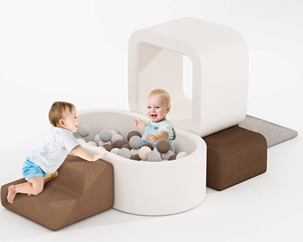
The most useful developmental toys usually aren't the complicated ones. Simple toys that pull a child into active participation give them the same skill over and over, which is exactly what they need. Knowing which kind of play does what makes it easier to set up a space where a toddler can explore safely and on their own terms.
Understanding Motor Development in Toddlers
Motor development is the gradual building of physical movement and coordination. It splits into two broad areas.
Gross motor skills use the larger muscle groups, mainly the legs, arms, back, shoulders and core. Walking, climbing, jumping, balancing, crawling, throwing.
Fine motor skills use the smaller muscles, especially in the hands and fingers. Picking up small objects, turning pages, stacking blocks, drawing, fitting pieces into openings. Each of those asks for a little more hand and finger control than the last.
The two aren't really separate. A toddler with better balance and body control finds it easier to sit steadily while doing something that needs precise hand movement, and time spent handling objects sharpens the coordination between what a child sees and what their hands do.
How Toys Encourage Gross Motor Skills
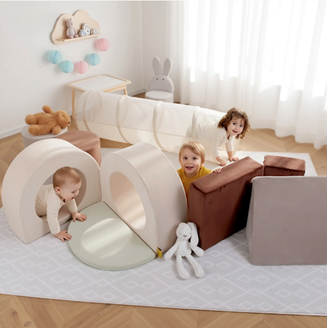
Toddlers need toys that get the whole body involved. Soft climbing structures, tunnels, foam blocks, balance equipment, push toys, age-appropriate balls.
Crawling through a tunnel means coordinating arms, legs and torso while judging whether there's enough room. Climbing over a soft structure means balance, shifting weight, planning the next move. Walking across a low balance surface means concentrating and staying controlled. None of it looks like training. All of it is.
Spatial awareness comes from the same activities. Moving around objects teaches distance, direction, height, and where their body sits in relation to everything else.
BanaSuper focuses on play equipment and toys built for movement, sensory exploration and physical coordination. Its range covers soft play categories including climbing and jumping equipment, play mats, play couches, arches, tunnels and foam-based play sets, all listed on the BanaSuper Official Website.
Fine Motor Skills Through Everyday Play
Plenty of ordinary toys and household activities handle fine motor development without any special effort. Building blocks, stacking toys, large-piece puzzles, chunky crayons, play dough, threading activities, simple shape sorters.
Look closely at what happens when a toddler picks up a block and sets it on another one. They're matching what they see to what their hand is doing, judging where the block should go, adjusting how hard they grip, then releasing at the right moment. It looks like nothing. It's a lot.
Turning pages in a board book builds finger control the same way. Crayons give practice at holding a tool and moving it across a surface. Simple construction lets a child handle objects while bumping into balance and cause and effect on their own.
None of it has to become a lesson. Let them explore at their own pace and the practice happens anyway, without play starting to feel like work.
Fine vs Gross Motor Skills
The distinction is genuinely useful when you're choosing activities. Gross motor play is large body movements and whole-body coordination. Fine motor play is controlled movement of the hands and fingers.
A child climbing over a soft foam obstacle is practicing balance, strength, coordination and body awareness. A child stacking small blocks is practicing visual tracking, grip control, hand-eye coordination and precision.
In real life the two rarely stay in their lanes. A toddler crawls toward a toy, sits down to pick it up, carries it across the room, then drops it into a container. One short sequence, both skill sets.
Understanding fine vs gross motor skills mostly helps you see that different kinds of play feed different parts of physical development. BanaSuper also publishes educational information about how these two areas relate.
The Role of Sensory Play
Motor development and sensory experience are tied together. Toddlers use touch, sight, hearing, movement and body-position awareness to make sense of where they are.
Sensory play can mean materials with different textures: soft fabrics, smooth surfaces, play dough, water, other age-appropriate sensory materials. Squeezing, scooping, pouring, touching, handling. Children get to find out how things feel and how they behave.
Movement delivers sensory input too. Crawling, climbing, balancing, rocking and jumping all let a child feel their body position change. A varied play space gives you both at once.
Safety still comes first. Materials and toys should suit the child's age, and anything with small parts that could be a choking hazard stays away from young children.
Choosing Developmentally Appropriate Toys
Two questions cover most of it. What can this child do right now, and what might this toy nudge them toward next?
A good developmental toy asks the child to do something rather than watch something happen. Open-ended toys work particularly well, because a child keeps finding new ways to use them as their abilities change.
For gross motor development, look at soft climbing pieces, tunnels, balance equipment, large building blocks or age-appropriate balls. For fine motor practice, stacking pieces, chunky puzzles, blocks, art materials and simple manipulation toys.
Worth asking too whether a toy can grow with the child. Something used for basic exploration early on often turns up later in imaginative play, obstacle courses, construction games or harder movement challenges.
Encouraging Independent Exploration
Toddlers learn by repeating things. The same action, many times over, because repetition is how they work out what their body and the object will do.
Your part is mostly providing a safe area and then stepping back. Correcting every attempt gets in the way. When the situation is safe, let them find the solution themselves.
A toddler building a tower will knock it down plenty of times before working out how to make it stable. A child climbing a soft obstacle moves slowly and cautiously at first, then stops being cautious because they've got it. Problem-solving grows right alongside the physical skill.
BanaSuper describes its approach as using companion toys to support sensory integration, motor skills, physical coordination, confidence, social skills and cognitive development through everyday play.
Creating a Balanced Play Environment
A toddler's space doesn't need to be full of toys. A smaller, varied selection covering movement, manipulation, creativity and sensory exploration does more than a big pile.
Mixing active toys with quieter ones helps. After climbing or jumping, a toddler often settles down to build with blocks or look through a picture book, and having that switch available between whole-body movement and focused hand work is the point.
Above all, play should stay safe, age-appropriate and enjoyable. Children develop at different rates, so toys are there to offer opportunities, not to push anyone toward a milestone on schedule.
The Short Version
Toddler toys earn their place when they get children moving, exploring, handling things and experimenting. Gross motor activities build balance, strength, coordination and body awareness. Fine motor activities build hand control, precision and hand-eye coordination. Sensory experiences fill in the rest, teaching them how textures, movement and physical sensations work.
You don't have to turn every toy into a developmental exercise. Give them a varied space, keep an eye on things, and let them move, create, discover and repeat as much as they want. The learning takes care of itself.