How to Teach Toddlers to Respect a Dog's Feeding Space
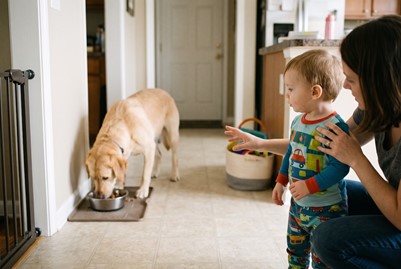
Learning to respect the eating area of the dog is very critical in ensuring safety and comfort at home for the young ones and the pets. Toddlers tend to be very curious and therefore they might end up touching the dog's food, moving his bowl or approaching him when eating. The dog, in turn, gets annoyed or threatened since he feels that his food is being interfered with. Parents can ensure that such conflicts do not arise through setting boundaries and showing how it should be done during mealtime.
Understanding a Dog's Feeding Behaviour
A dog might be protective about his/her food since feeding plays an integral part in its daily activities. Dogs that allow people to get close to them are relaxed when it comes to feeding. Other dogs may become anxious when approached while eating since the person coming close could be seen as a threat. The toddler will not comprehend the signals of aggression which could include growling and pulling away from a person.
Another reason for a dog biting a child may be the ignorance of the child to the concept of personal boundaries. The child does not know why a dog wants privacy when eating. The child can see the act of approaching the dog as a natural interaction and taking food from him/her as an opportunity to interact with the pet. It is vital to explain that the dog needs time alone when eating.
Establishing Clear Feeding Boundaries
Designating an eating space is one of the most efficient methods of teaching toddlers the places where they shouldn't be close to a dog. The parents can set the dog's food and water bowls in some quiet corner, behind the baby gate, or some other place that kids couldn't reach on their own. Thus, the dog will have enough space for feeding and won't feel uncomfortable with any distractions. The consistent place for eating will also make the toddler understand that there is something special about this place.
The parents need to introduce some easy household rules for the whole process of the dog's feeding. For instance, the toddler should know that he or she shouldn't come near the bowl, touch the dog's food, or disturb the dog during its eating. The use of short and clear words will make it easier for the child to memorize these rules.
Encouraging Positive Pet Care Habits
Through various activities that do not entail the direct handling of the dog’s food bowl, toddlers can acquire responsibility regarding the keeping of pets. Toddlers can be allowed by their parents to select a feeding mat, help transport an empty food dish, or inform adults whenever the time to feed the pet comes.
Parents can also explain to their children that dogs require healthy and nutritional meals in order to stay healthy and active. During this process, parents can educate the children that each animal requires its own food depending on their nutritional needs. Thus, the best dog food would be that which caters to the needs of the dog. Similarly, the best cat food should cater to the nutritional needs of the cat.
Demonstrating Appropriate Behaviour
The younger generation learns by observing adults. Parents can teach respect by preparing the food for the dog without having toddlers around him/her during his/her meal time. They can describe each step to toddlers in simple words that mealtime is a time when the dog needs to be left alone. Such lessons will enable children to understand that household rules are related to daily routines and not just arbitrary prohibitions.
Parents also need to demonstrate how to behave with the dogs in the absence of mealtimes. Children will learn how to approach them calmly, act gently and wait for the right moment to play with the dog. Even if the child wants to give him toys or some treats, adults have to control such actions from behind the scenes. Such treats as bully sticks will make the dog happy because he/she will have something to chew, but the child should not get close to him/her.
Maintaining Consistent Supervision
A watchful eye is necessary when toddlers and dogs live together especially when meals are served. Despite the fact that children are aware of the house rules, sometimes they can be distracted by things around them. It is advisable for parents to be near to prevent the situation when a toddler tries to get closer to the place where the dog eats or wants to play with its food. Physical barriers offer an extra layer of protection in cases when parents cannot watch their child.
Another thing that needs to be considered is a dog’s reaction to the presence of children. Signs of growling, food guarding and tense behavior need to be considered and not be punished in any way. Parents should take their toddler away and consult a veterinarian or a professional dealing with animal behavior problems.
The training for toddlers on respecting the eating space of the dog involves consistency and supervision from the parents. Parents can teach their children how to respect the animals through the provision of feeding areas, showing them how to behave, and teaching them how to take care of the pets. In addition, such practices can instill compassion and understanding of personal needs in children.