How to Prepare for Your First International Trip with a Baby
Four hours into our first flight with a nine-month-old, my daughter slept through the landing announcement. The problem wasn’t the journey. It was everything we forgot before we left the house. A missing birth certificate at check-in, a phone with no signal at arrivals, and a suitcase built for a version of parenting that didn’t exist yet.
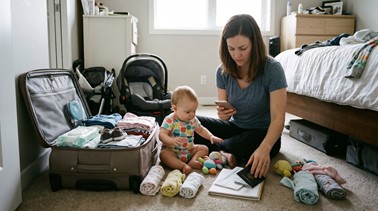
The fix isn’t a bigger checklist. It’s a short one, organized by the country you’re actually flying to, because the paperwork and the practicalities change the moment you cross a border. Here is the setup that worked the second time around, starting with the first country on most itineraries and the one where you can solve a lot of problems before you board.
Start With the Country, Not the Suitcase
Every guide to traveling with an infant treats the trip as one big blob of preparation. It isn’t. Your passport rules, your car seat legality, your milk allowances, and your data coverage all depend on where you’re landing. Pick your destination first, then build three short lists around it.
I’d argue the country list matters more than the packing list for one simple reason. You can buy almost anything you forget at a pharmacy abroad. You cannot buy a valid passport at the airport.
North America first
If your first stop is the United States or Canada, get the passport sorted the day you book. Many countries waive visa requirements for infants, but the passport itself is rarely optional, and processing times can stretch for weeks. Check your own government’s travel portal rather than a forum. For British families, the UK government lists current entry requirements per country and updates them regularly.
Then think about your phone. An eSIM for North America covers the US, Canada, and Mexico in one package, and activates and connects the moment you land. That matters when you’re standing in a rental car queue with a crying baby and need to call your hotel. Sorting it out at home is far better than finding a roaming surprise on your bill.
Europe next
Within the Schengen area, an infant usually travels on their own passport or on a parent's document depending on the country. France, Spain, and Italy all have their own wrinkles, and the rules for a British or American baby differ from those for an EU citizen. Read the specific country page, not the continent summary.
Coffee shop changing tables, train platforms with lifts, and hotel cots vary wildly between capitals. If you're doing a multi-city route, treat each stop as its own mini trip with its own two-hour buffer.
Asia and long haul
Flights over ten hours change the plan. Book a bassinet row where the airline allows it, and confirm the weight limit when you check in, because they differ by carrier. Japan, Singapore, and Thailand are famously welcoming to babies and equally strict about documentation. Carry printed copies of everything, since a tired customs officer at 2 a.m. doesn't want to squint at your phone.
The Two-Bag Rule for Baby Gear
Most parents pack for the baby they have at home. Pack for the baby you'll have on day three, when everyone is exhausted, and nothing is where it should be. I use a rule with two parts, and it has never failed us.
* Bag one is the twenty-four-hour bag. It holds enough nappies, formula, changes of clothes, and wipes to survive a full day with zero access to a shop. It travels in the cabin, not the hold.
* Bag two is the recovery bag. It sits in the suitcase and covers the first two days at your destination: one familiar sleep sack, one comfort toy, a thermometer, and a full set of spare clothes for you as well as the baby. Two bags, two jobs. That's it.
Everything else you can buy there. A travel cot, a stroller, even formula is available in most cities, and hauling it through three airports is a special kind of punishment.
* Passports and visas for every traveler, photocopied and stored separately
* A signed consent letter if only one parent is traveling
* Nappies, wipes, and formula for the journey plus one full day
* One comfort item that never leaves the cabin bag
* Charged phone with an offline map downloaded before departure
* Basic baby medicine in its original packaging, checked against your destination's rules
The 3 a.m. Kitchenette Scenario
Here's the moment nobody plans for. You land at night, the baby is wired from the flight, and you need to warm a bottle in a hotel room with no kettle. We hit this in Toronto, and the fix took two days to figure out.
Book accommodation with a kitchenette, even if it costs a little more, and confirm it has a kettle or microwave before you pay. A studio apartment beats a fancy hotel room when you're sterilizing bottles at midnight. Bring a small travel kettle if you're unsure, and pack a folding bottle brush. This is the kind of detail that never makes it into a generic packing list, and it's the one you'll remember. Ask the hotel in advance whether they can store expressed milk or formula in a fridge. Almost all will, but you have to ask before arrival, not at the front desk at 3 a.m.
Health and Jet Lag, Handled Simply
Before you book, check the destination's vaccination requirements for infants. The CDC publishes country-specific travel health guidance, and it's worth reading alongside your own doctor's advice. Some routine vaccinations have minimum age limits, so the timing of your trip can actually depend on your baby's age.
For jet lag, shift the schedule in fifteen-minute increments starting two days before you fly, and protect the first night's sleep at all costs. A baby who sleeps through the first night adjusts faster than one who doesn't. Daylight, not gadgets, does most of the work.
Airport Day Without the Meltdown
Give yourself an extra hour. Not because security will take longer, but because everything with a baby takes longer and you'd rather be early than frantic. If you're flying to or through the United States, the Transportation Security Administration publishes current rules on formula, breast milk, and baby food, and they're more generous than most parents expect. Print the page and keep it with your documents. Feed on takeoff and landing to help with ear pressure. Board last if you can, since sitting on a plane for an extra forty minutes with a mobile baby is nobody's idea of fun. And pack a spare top for yourself, because the one time you don't, you'll need it.
What to Do This Week
Book the passport appointment today. Check the destination country page on your government's travel site. Reserve a kitchenette room. And sort your data plan before the week is out, so the last thing on your mind is a dead phone at baggage claim. The trip will still have surprises. They just won't be the expensive kind. What's the one thing you wish someone had told you before your first flight with a baby?