How to Build Magical Story Worlds for Your Little One (Without Being a Writer)
There's something quietly wonderful about watching a small child disappear into a story. One minute they're squabbling over the last raisin, the next they're a dragon, or a pirate, or a small bear looking for honey. Imagination is one of the biggest things happening in the under-5 years, and the more you feed it, the more it grows.
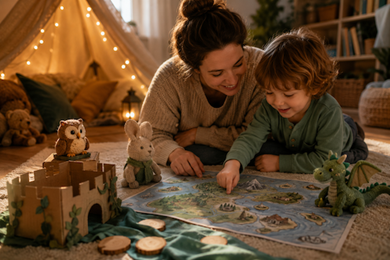
You don't need to be a children's author to build a little story world for your child. You just need a few simple ideas, a bit of repetition, and maybe one or two tools that make it easier to keep things going. Below are some gentle ways to bring more storytelling and imaginative play into your home, whether your child is two and just learning to point at pictures, or four and ready to invent entire kingdoms over breakfast.
Start With a Place
Every good story has a place where it happens. For very young children, that place doesn't need to be complicated, a "magic forest behind the kitchen," a "tiny island that floats in the bath," a "land where all the lost socks live." Pick somewhere that you can come back again and again. Repetition is what helps under-5s feel safe and excited at the same time, which is the sweet spot for play.
You can describe the place out loud, but a lot of children respond more strongly when they can see it. This is where a simple printed map can be magical. An AI fantasy map generator lets you type a short description of an imaginary place, "an island with a forest, a sleepy dragon, and a beach made of marshmallows", and it generates a styled little map you can print out and hand to your child.
A few ways parents are using it:
* Bedtime story maps. Print a map of the world in which your bedtime stories take place. Children love being able to point to where the story is happening tonight.
* Indoor treasure hunts. Draw an X on the printed map and hide a small treat in the house at the matching spot ("the cave" is under the kitchen table).
* Rainy-day play. Tape it to the wall and let your toddler add stickers, scribbles, and their own additions over time.
It costs nothing, takes about a minute, and gives your child something physical to anchor their imagination to.
Give the World a Few Characters
Small children love recurring characters. A made-up bunny called Pip, who lives in the magic forest, is more powerful than ten different made-up animals across ten different stories. Pick two or three characters and bring them back regularly. They can have very simple personalities. Pip is shy, the Owl is bossy, and the Tiny Dragon is always hungry. That's all you need.
A few gentle tips that help:
* Let your child name at least one character. Ownership matters, even at age two.
* Give each character one funny habit. The Tiny Dragon sneezes glitter. The Owl always loses her glasses.
* Reuse the characters in everyday life. "I think Pip would love these strawberries." It blurs the line between play and the real world in a way that lights small children up.
Make Up Little Rituals and Rules
The fun of an imaginary world, for a young child, is partly in the rules. Bedtime stories told in the same place every night, with the same opening line ("Once upon a time, on the marshmallow beach…"), are doing a lot of quiet developmental work. They give your child language patterns, narrative structure, and emotional rhythm without anyone calling it "learning."
You can build in:
* A magic word that starts the story.
* A song or rhyme that comes back in every adventure.
* A "rule of the world", maybe nobody in this land is ever cross for very long, or animals can talk on Sundays.
These tiny details are what turn a few made-up stories into a world your child genuinely lives in.
Bring the Story Into Play
Once you have a place and a few characters, almost anything can extend the world. A cardboard box becomes Pip's house. A scarf becomes the river that runs through the magic forest. Cushions on the floor become stepping stones across the marshmallow sea. None of this needs to be Instagrammable; under-5s aren't looking for aesthetics, they're looking for invitations.
If your child likes drawing, try giving them a corner of the printed map and asking what's there. You'll often get an answer that's better than anything you would have come up with. ("That's where the cake fairies live, but they're sleeping.")
A Word About Screen Time
Most of the ideas here are screen-free, and that's deliberate. Using a tool like the map generator works best as a quick parent task: make the map, print it, close the laptop, and the rest of the play happens off-screen. The map becomes a paper object your child interacts with, not another reason to look at a screen.
For parents trying to keep tech use thoughtful in the early years, that's often a useful test for any digital tool: is it doing five minutes of work for me so we can have an hour of play together? If yes, it's earning its place.
You Don't Need to Be Good At This
This is the most important part. You don't need to be a natural storyteller, a craft-pinterest parent, or someone who remembers what happened in last night's story. Children under five are extraordinarily forgiving audiences. They will laugh at the silliest joke, accept the wobbliest plot, and ask for the same story every night for six months without minding that you've forgotten which character has the squeaky voice.
The point isn't to build a perfect imaginary world. It's to give your child the experience of going somewhere together, somewhere only the two of you know about, and coming back. That's the bit they remember, long after the maps and the characters fade.
Frequently Asked Questions
1. What age is best for starting story worlds with children?
Anytime from around two onwards, though the form will change with age, a two-year-old might just enjoy pointing at a printed map and naming what they see. A four-year-old can take an active role, naming characters, adding rules, even drawing parts of the world. There's no "right" age to start; the stories simply grow alongside your child.
2. How long should a bedtime story like this last?
For most under-5s, five to ten minutes is plenty. Young children's attention spans are shorter than we sometimes expect, and a short story told well, with the same characters and the same little rituals, is much more valuable than a long one that they drift in and out of. If your child is asking for more, that's lovely. If they're ready to roll over and go to sleep after five minutes, that's a win too.
3. Do I need to be creative or artistic to do this?
No, honestly. The whole point is that the stories don't need to be clever or original, they just need to be yours and your child's. Repetition, warmth, and a few familiar characters do almost all of the heavy lifting. Even parents who say "I'm not creative" usually find that once they start, the stories come more easily than they expected. Small children make excellent collaborators.
Author Bio
Nimisha Sureka is a SaaS (Software as a Service) content writer at Anchorial, a link-building agency. With extensive experience writing for SaaS brands from early-stage startups to established platforms, she specializes in turning complex products into clear, compelling narratives that rank, resonate, and convert.