Hello Kitty Colouring: A Fun and Creative Activity for Kids
Colouring is one of those simple things that seems easy but does so much for a child's development. A familiar character, a few fun shapes and simple outlines can transform colouring into a really fun way for a child to explore their creativity. Hello Kitty drawings tend to be a big hit with younger kids specifically, thanks to how simple and instantly recognisable the character's features are.
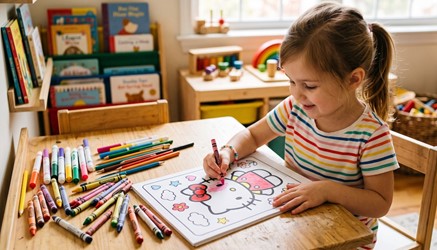
Whether a child's colouring solo or sitting alongside a parent, sibling, or teacher, working with a familiar character can turn what might otherwise be a quiet, low-key activity into something with real learning, imagination, and self-expression baked into it.
Why Colouring Actually Matters for Kids
Colouring is more than just filling in space with crayons. For young kids, it genuinely builds hand control and coordination - holding a colouring tool and guiding it across a page takes real eye-hand coordination, even if it doesn't feel like "work" to a five-year-old.
Over time, those small movements build the same fine motor skills a kid needs for writing, using scissors, buttoning a shirt, or handling small objects at school. It's not a coincidence that coloring shows up so often in early childhood classrooms.
There's a concentration angle too. A kid might start out colouring big, broad areas and gradually get better at paying attention to smaller details and tighter spaces. And finishing a page - even a simple one - gives them a small, genuine sense of accomplishment.
Why Character-Based Colouring Works So Well
Kids naturally gravitate toward familiar faces. A recognisable character makes an otherwise ordinary colouring page feel a lot more interesting, and that tends to keep a kid engaged with it longer than a generic shape or pattern would.
Hello Kitty works particularly well for younger children because her design is genuinely simple - big shapes, clear facial features, outlines that aren't overly complicated. That simplicity makes the pictures a lot easier for a young child to actually understand and color confidently.
Parents and teachers can use Hello Kitty drawings as a jumping-off point for bigger conversations too - about colors, shapes, emotions, or storytelling. Instead of just saying "color this in," it can help to ask what the character's doing, or where she might be headed in the picture.
Picking Colouring Sheets That Actually Fit the Kid
The difficulty of a colouring page really should match a child's age and current skill level. Younger kids tend to do better with larger sections and fewer fine details, while older kids often enjoy something more complex - patterns, backgrounds, smaller areas to fill in.
When picking out colouring sheets for kids, it's worth paying attention to how small the individual sections actually are. Tiny, fiddly areas can genuinely frustrate a kid whose hand control is still developing.
Paper matters more than people expect too. Regular drawing paper usually works fine for crayons, but markers or certain paints often need something thicker so ink or moisture doesn't bleed through the page.
Let Creativity Take the Lead, Not Rules
The cool thing about colouring is that there is no “correct” result. A child may choose a strange colour scheme, create an entirely different background, or give a familiar character a completely new look.
It helps for adults to resist the urge to focus too much on staying inside the lines or using "realistic" colors. Learning some control is useful, sure, but creativity should stay front and center in the activity, not get squeezed out by perfectionism.
A kid deciding Hello Kitty has a purple bow, a green dress, or a rainbow background isn't doing it wrong - that's them making independent choices and expressing their own preferences, which is honestly the whole point.
Turning Colouring Into a Bit of a Learning Moment
Colouring pairs naturally with a lot of early learning concepts. Parents can ask what color a child's using, or have them count objects scattered through a picture. Shapes within a drawing open up easy conversations about circles, rectangles, triangles, and other basics.
It's also a decent way to practice vocabulary - asking a kid to describe their finished picture, or questions like "What's happening here?" or "Who's with the character?" tends to get them talking about their own ideas in a low-pressure way.
For older kids, colouring can turn into a bigger storytelling exercise. Once the picture's done, they can build a short story around the character and the setting they've created.
A Genuinely Screen-Free Option
Today there is no shortage of digital entertainment for kids, and that is exactly why you want to cling to screen-free activities for the sake of variety. Colouring fills that gap nicely. No phone, tablet or computer required, just paper and something to colour with.
A small stash of colouring pages, crayons, pencils, and washable markers is enough to set up a simple creative corner at home. It's genuinely useful for free time, rainy afternoons, school breaks, or just something to do as a family.
And unlike most digital activities, colouring leaves behind something physical - a picture a kid can actually hang up, hand to grandma, or tuck away in a folder somewhere.
Making It a Shared Activity
Kids can definitely colour on their own, but when adults get involved every once in a while, it makes the activity feel so much more important. A parent colouring with their kid, talking about what colours to use, or making their own version of the same picture adds something real to the experience.
Siblings and friends colouring together works well too - it gets kids sharing materials, comparing ideas, and noticing how differently two people can approach the exact same picture.
The goal was never a perfectly finished, magazine-worthy page. The real value is in the process - picking colors, controlling movement, experimenting with combinations, and ending up with something that's genuinely theirs.
Bottom Line
Colouring gives kids a simple, low-pressure way to combine creativity, focus, and fine motor practice all at once. A familiar character makes the activity that much more engaging, and simple, well-chosen pages can flex to fit almost any age or skill level.
Drawing Hello Kitty is an easy way in for kids who like the characters. Carefully selected colouring sheets for kids can be both fun and educational in one sitting. Most importantly, colouring allows children to experiment and create freely- no expensive equipment, no complicated setup, just paper, colour and a little imagination.