Beyond Soft Play: Introducing Your Toddler to the Things You Enjoy
Somewhere in the first couple of years, family time quietly becomes their time. You go where they want to go, you do what they can manage, and a lot of Saturdays are spent perched on the edge of a ball pit wondering when you last chose the activity.
That’s fine, and a fair bit of it is necessary, but toddlers aren’t especially fussy about what they’re doing, they’re just interested in doing it with you. Children aged one to five are meant to be active for at least 180 minutes a day, and none of that has to happen on a plastic slide.
Making Something Together
If you paint, throw pots, sew or build things you’ve already got the hard part sorted, which is caring about it. Small children pick up on that faster than you’d expect.
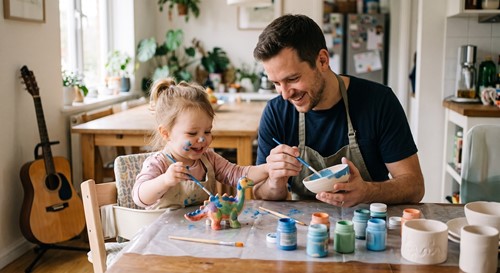
Pottery painting studios are the easiest way in. Most will hand a two-year-old a small piece and a brush and let them get on with it, and the fired result comes home a week later looking like a proper object rather than another drawing for the fridge. At home, keep your expectations low and your surfaces covered. A two-year-old wants to feel the paint move about, and whether it ends up resembling anything isn’t their concern.
The bit that makes the difference is working on your own piece alongside them rather than hovering over theirs. If you want more to work with, there are plenty of creative play ideas you can set up outdoors with almost no kit at all.
Sharing The Music You Love
Anyone who plays an instrument has the most receptive audience they’ll ever get sitting right there on the rug.
At two, it’s all cause and effect. Let them press the keys, thump the strings or hold the shaker while you play, and don’t correct a thing. Around the age of four it shifts, and they start wanting to copy you properly. That’s when a cheap ukulele or a secondhand keyboard earns its keep.
Play the music you actually like as well as the songs they know. Young children are far more open to unfamiliar music than adults assume, and you’ll both get more out of twenty minutes that isn’t the same nursery rhyme for the ninth time that day.
Finding a Sport That Works for Both of You
Most sports are hard work with a toddler, because they involve either a lot of running or a lot of waiting, and small children are poor at both. There are, however, a few that hold up better.
Swimming is the obvious one, since you’re both in the water doing the same thing. A balance bike lets them come along rather than trail behind the buggy. Foam rackets and a soft ball will get you a decent twenty minutes in the garden once they’re around three. If golf is your thing, it survives the toddler test better than most, largely because so much of it happens on the spot. Crazy golf is the obvious first step. A three-year-old can hold a putter, hit a ball and watch it go somewhere, and an hour of that is good fun for both of you.
If crazy golf leaves you wanting a proper swing, there’s a stay-at-home option too, and for plenty of parents it’s the one they’d pick anyway. The snag is that a real ball and a back fence are a poor combination even without a toddler wandering about behind you. A decent practice net solves that, and they’re easy enough to find. Specialists such as Golf Swing Systems supply ones built to take a full swing at home, weighted and pegged so they stay put through British weather.
Switch to airflow balls while your little one is out there, give them a couple of plastic cups sunk into the grass well behind you, and you can both get on with it. It saves loading everyone into the car with a changing bag, and doing it in the garden means nobody has to be talked into shoes.
Taking Them to Something You’d Watch Anyway
Theatre sounds like a stretch with a toddler, and a West End matinee probably is. Shows made for under-fives are a different proposition. They run about forty minutes, the lights stay half up, nobody minds if your child stands and talks through the middle of it, and the room is full of people in the same position.
Puppetry and music-led shows work best below three. From four or so, story-led productions start to land properly. Look for early years or relaxed performances rather than anything with a stated minimum age, and book a daytime slot while everyone is still cheerful. If you’re not sure what’s on locally, you can search for family arts events near you by area.
Why It’s Worth The Effort
None of this replaces the park, the toddler group or the soft play centre, but there’s a real difference between an afternoon you’ve sat through and one you’d have picked yourself, and you’ll be better company when it’s something you enjoy too.
They notice that. It’s most of what they came for.