7 Simple Science Activities for Toddlers and Preschoolers (Using Things You Already Have)
Ask any parent of a three-year-old and they will tell you: small children are natural scientists. They drop spoons from the high chair to see what happens, pour water from one cup to another for twenty minutes, and ask "why?" more times before breakfast than most adults do all week. The good news is that you do not need a lab, a big budget or a science degree to feed that curiosity. A kitchen table, a few household bits and a little patience are enough.
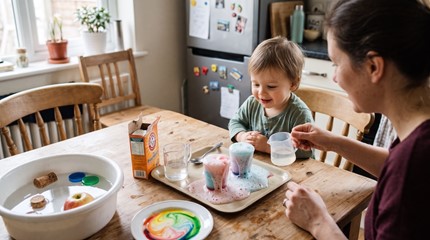
Below are seven easy activities that work brilliantly with toddlers and preschoolers, plus a few tips on keeping the wonder going once the mess is tidied away.
Before you start: three golden rules
* Stay close. Every activity here needs an adult within arm's reach. Small parts, water and anything edible-looking should always be supervised.
* Let them lead. The goal is not to get the "right" result. If your child would rather stir the bubbles than watch them, that is still learning.
* Talk out loud. Simple questions like "What do you think will happen?" and "Why did it do that?" turn play into science without anyone noticing.
1. Sink or float
Fill a washing-up bowl or the bath with water and gather a handful of objects: a cork, a metal spoon, an apple, a plastic bottle lid, a leaf, a pebble. Before each object goes in, ask your little one to guess whether it will sink or float. Children love being "right", and they love being surprised even more. The apple is usually the star of the show, because most toddlers expect it to sink.
What they learn: early ideas about weight, size and density, and the habit of making a prediction before testing it.
2. Rainbow milk
Pour a thin layer of full-fat milk into a plate, add a few drops of different food colouring, then dip a cotton bud in washing-up liquid and touch it to the middle. The colours suddenly swirl and race away from the cotton bud. It looks like magic, but it is the soap breaking the surface tension of the milk and reacting with the fat. For older preschoolers, try it with skimmed milk too and compare.
What they learn: cause and effect, colours mixing, and that "magic" usually has an explanation.
3. Fizzing volcanoes
A classic for a reason. Put a couple of spoonfuls of bicarbonate of soda in a cup on a tray, add a drop of food colouring, then let your child pour in some vinegar. Cue lots of fizzing and very excited squeals. You can build a "mountain" around the cup with playdough if you are feeling ambitious. Keep the vinegar in a small jug so the pouring is easy to control.
What they learn: that mixing two things can make something new, in this case a gas that makes bubbles.
4. Ice excavation
The night before, freeze small plastic toys in a tub of water. In the morning, give your child the ice block on a tray with warm water in a squeezy bottle, a little salt and a spoon. Their mission is to rescue the toys. It can keep a toddler busy for a surprisingly long time, and you can talk about which method melts the ice fastest.
What they learn: melting and freezing, and how warmth and salt change ice.
5. Shadow play
On a sunny day, take chalk outside and draw around your child's shadow in the morning, then again after lunch. Why has it moved? Why is it shorter? Indoors, a torch and a few toys on a wall make a mini shadow theatre for rainy afternoons. Move the torch closer and further away and watch the shadows grow and shrink.
What they learn: light travels in straight lines, objects block it, and the sun appears to move across the sky during the day.
6. Growing cress heads
Draw a face on an empty eggshell or a yoghurt pot, fill it with damp cotton wool and sprinkle cress seeds on top. Within a few days, your child's creation will grow a head of green "hair" that can be trimmed and added to a sandwich. Put one pot on a sunny windowsill and another in a dark cupboard to see what difference light makes.
What they learn: what plants need to grow, and how to observe something changing over several days.
7. Stargazing from the bedroom
Young children often go to bed before the stars come out, especially in summer. On a clear winter evening around teatime, wrap up warm and step outside to look for the Moon and the brightest stars. Back inside, a simple star projector or a glow-in-the-dark ceiling can turn bedtime into a nightly trip to space, and it is a gentle way to start conversations about the planets, the Moon's changing shape and why it gets dark.
What they learn: day and night, the Moon's phases, and a sense of how big the world beyond our windows really is.
Keeping the curiosity going
The activities above cost almost nothing, but there is also a place for a few well-chosen science toys, especially as birthdays and Christmas come round. When choosing, check the age guidance carefully: many science kits are designed for children aged six and over, and some contain small parts or strong magnets that are not suitable for little ones. For under-fives, look for toys they can explore with their hands and eyes rather than kits that need precise instructions.
As children reach school age, proper science kits become a fantastic way to build on what they have discovered at home, from growing crystals to building simple circuits. If you have a budding astronomer, it is worth browsing the space-themed ideas too, as night lights and projectors make bedtime something to look forward to. Specialist shops such as Science Gifts group their ranges by theme and age, which makes it much easier to find something that fits your child's stage rather than guessing.
A final thought
You do not need to know all the answers. Some of the best moments come when your child asks a question you cannot answer and you find out together. "Let's test it" is one of the most powerful phrases a parent can use. It teaches children that the world can be understood, one experiment at a time, and that getting it wrong is just part of the fun.
So clear the kitchen table, roll up those sleeves and get experimenting. The mess is temporary, but the curiosity you spark can last a lifetime.