7 Postnatal Exercises You Can Do With Your Baby at Home
Official UK guidance counts playing with your newborn as exercise. Here is how to turn nap-time, feeds and floor play into a safe, evidence-backed recovery routine.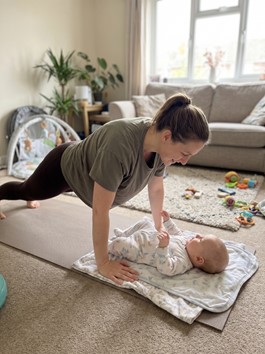
The UK Chief Medical Officers’ guidance for women in the year after birth lists “playing with your newborn” alongside walking, yoga and dancing as moderate-intensity activity. That single line changes the question for new mums: not how to find time away from the baby, but how to move with them. It is also the principle at the heart of any good pre and post natal personal training course: build recovery around real life, not in spite of it.
The seven exercises below need no equipment, no childcare and no gym. Each is matched to what NHS physiotherapists and recent research actually say, including when to start and when to hold back.
Why exercising with your baby counts
The official target is clear. The UK Chief Medical Officers advise new mothers to work up to at least 150 minutes of moderate activity a week, start pelvic floor exercises as soon as they can and continue daily, and rebuild muscle-strengthening work to twice a week. Their guidance states that it is safe to be active, that there is no evidence of harm for postpartum women, and that you can be active while breastfeeding.
The obstacle is just as clear. Research released by Sport England’s This Girl Can campaign in January 2026 found that 57% of pregnant women and mothers of babies under one had felt unwelcome or excluded when trying to get active. Among those whose activity had dropped, 46% said they were too tired from childcare and 38% struggled to find time around a newborn. Nearly a third (32%) worried about harming their baby.
Time is the recurring theme. In an earlier UK evaluation, not one new mum surveyed said she always had time to be active, yet 59% often or always set aside time each week and 65% built activity into daily life.
Support from professionals also tends to fall away once the baby arrives. In Canterbury Christ Church University’s This Mum Moves evaluation, 60% of women in their first trimester agreed that healthcare professionals encouraged them to be active. Postpartum, that fell to 19%. The postpartum group was small (18 women, surveyed during Covid restrictions), so treat the figure as indicative rather than definitive.
Does the baby being there blunt the benefit?
The evidence suggests not. In a small Canadian crossover study published in 2010, 23 postnatal women completed two 45-minute moderate aerobic sessions, one with their baby present and one without. Mood and anxiety improved significantly after both sessions, with no difference between them.
The mental-health case for moving at all is growing. A network meta-analysis published in Frontiers in Psychiatry on 30 September 2026 pooled 24 randomised trials and 1,792 women. Exercise was linked to scores on the Edinburgh Postnatal Depression Scale that were 2.73 points lower, on average, than usual care. The authors stress the trials varied widely and the average effect was smaller than the 4-point threshold they used for clinical importance. They describe exercise as a useful addition to postnatal mental-health care, not a replacement for it.
As Kate Peers, strategic lead for campaigns at This Girl Can, puts it: “Even just 10 minutes can bring real benefits for mood, energy and confidence.”
When can I start?
Pelvic floor exercises and gentle walking can begin from day one after both vaginal and caesarean births. Everything else depends on how you delivered. These timings come from the postnatal physiotherapy leaflet issued by St George’s University Hospitals NHS Foundation Trust.
Type of exercise - After a vaginal birth - After a caesarean
Pelvic floor exercises - From day one - From day one
Gentle walking, as pain allows - From day one - From day one
Low-impact exercise (postnatal class, yoga, Pilates) - from 6 weeks - From 8 weeks
High-impact exercise (jogging, jumping aerobics, heavy weights) - From at least 12 weeks - From at least 14 weeks
The same leaflet advises women who have had a caesarean not to lift anything heavier than their baby for six weeks. It also lists warning signs to stop and seek a pelvic health physiotherapist: pain, difficulty controlling your bladder or bowels, heaviness or dragging in the pelvis, or bulging or doming of the tummy.
These are general timings, not a sign-off. Everyone heals at a different rate, so check with your GP or midwife if you are unsure, especially after a difficult birth.
The 7 exercises
1. Pelvic floor squeezes during feeds
When: from day one, after both vaginal and caesarean births.
Feeds come round many times a day, which makes them a ready-made reminder. Sitting supported, tighten the muscles around your back passage and vagina, lifting up and in as if stopping wind and urine. Don’t clench your buttocks or hold your breath.
St George’s physiotherapists suggest two drills, three to four times a day. For endurance, hold for up to 10 seconds, relax for the same time, and repeat 10 times. For speed, squeeze quickly then relax for at least five seconds, up to 20 times.
Why it comes first: NHS England estimates that about one in three women have urinary incontinence three months after pregnancy, and around one in seven have anal incontinence six months after birth. Many keep quiet about it. NHS perinatal pelvic health services in England are now meant to accept self-referrals for at least 12 months after birth.
2. Brisk pram or buggy walks
When: gentle walking from day one, building speed and distance gradually.
Walking is the easiest way to chip away at the 150-minute target, and it gets you both outside. Start with short loops near home. As you recover, push the pace until you can talk but not sing, which is a common rule of thumb for moderate intensity.
Keep the handlebar at a height that lets you walk tall rather than hunch. Walking was also the most common activity new mums reported in the This Mum Moves surveys, and several described buggy-based classes and running with a buggy as their way back into exercise.
3. Glute bridge with baby on your hips
When: from 6 weeks after a vaginal birth, 8 weeks after a caesarean (low-impact).
Lie on your back, knees bent, feet flat and hip-width apart. Rest your baby on your lower tummy or hips, holding them securely with both hands. Breathe out, gently draw up your pelvic floor, and lift your hips until your body forms a straight line from shoulders to knees. Lower slowly.
Start with 8 to 10 reps. Babies tend to enjoy the rise and fall, and you get a natural reason to make eye contact through the set. If you feel pressure in your pelvis or see your tummy dome, stop and get advice.
4. Baby-in-arms squats
When: bodyweight squats can be built in gradually; adding your baby’s weight is best left until low-impact work feels comfortable.
The CMO guidance asks new mothers to rebuild muscle strengthening to twice a week. Your baby is a weight that grows with you. Hold them close to your chest, feet a little wider than hip-width, and sit back as if onto a chair. Breathe out as you stand.
Progress slowly. In a Norwegian study of 300 first-time mothers, women who reported heavy lifting 20 or more times a week were roughly twice as likely to have tummy-muscle separation (odds ratio 2.18). That is an association, not proof that lifting causes separation, but it is a good reason to prioritise technique over load. After a caesarean, St George’s advises against lifting anything heavier than your baby for six weeks.
5. Mother and baby yoga flow
When: from 6 weeks (vaginal) or 8 weeks (caesarean).
A simple sequence works on the floor with your baby beside you: cat-cow on all fours, child’s pose, gentle side-lying stretches and a supported bridge. Sing or talk to your baby as you move, or let them watch from a play mat.
Of all the exercise types compared in the September 2026 Frontiers in Psychiatry analysis, yoga and mind-body exercise ranked highest for lowering postnatal depression scores. The authors rated the certainty of that comparison as very low, and many yoga programmes included extras such as counselling. Treat it as an encouraging signal rather than proof that yoga beats other activity.
6. Gentle core work during tummy time
When: from the early days, if comfortable.
Lie on the floor face to face with your baby during tummy time. On your back with knees bent, breathe in and let your tummy rise. As you breathe out, gently draw your lower tummy towards your spine and hold for two or three breaths. St George’s suggests five repetitions, building to pelvic tilts in which you add a pelvic floor squeeze and flatten your lower back.
Tummy-muscle separation is common and usually improves. In the Norwegian study, it affected 60% of first-time mothers at six weeks after birth, 45.5% at six months and 32.6% at a year. Bulging or doming along the midline is a sign to stop and see a pelvic health physiotherapist.
7. Kitchen dancing with your baby
When: gentle swaying from early on; more energetic moves as your recovery allows.
The official guidance names both dancing and playing with your newborn as moderate-intensity activity. Hold your baby securely, or wear them in a well-fitted carrier, put on a song and move. Sway, step side to side, march on the spot. Three or four songs add up to around ten minutes.
Keep bouncing and jumping out of it until high-impact exercise is appropriate: at least 12 weeks after a vaginal birth and 14 after a caesarean.
Making it stick, and when to get help
Short and regular beats long and rare. The CMO guidance says to start gradually if you were inactive, and to restart gradually if you were active before. Ten minutes of floor work during nap time and a daily buggy walk will cover a good share of the weekly target.
Stop and speak to your GP or a pelvic health physiotherapist if you notice any of these:
* Pain that doesn’t settle
* Leaking urine, wind or faeces
* Heaviness, pressure or a dragging feeling in the pelvis
* Bulging or doming along the middle of your tummy
Exercise can lift mood, but it is not a substitute for care. If low mood isn’t lifting, talk to your GP or health visitor.
The seven moves above are a foundation, not a finish line. Running, jumping and heavy lifting come later, from at least 12 weeks after a vaginal birth and 14 weeks after a caesarean. The habit you build now, moving with your baby rather than around them, is the one that makes that next step possible.